
Beyond the Simulator: The New Industries Exploding as Indoor Golf Takes Off
Quick Answer
Indoor golf isn’t just “golf, but inside.” In recent years, it’s helped expand the broader golf ecosystem by fueling off-course participation growth and changing how people play, practice, and socialize around the game (NGCOA / American Golf Industry Coalition talking points citing NGF). That surge has also created entirely new sub-industries—24/7 self-serve simulator clubs, dedicated booking/operations software, home-sim installation services, league/tournament formats, and hospitality-first “simulator bars”—all designed to make golf accessible when daylight, weather, time, or tee times don’t cooperate (Axios Denver) (Reuters).
Our own directory now tracks 2,359 golf simulator venues across the U.S., and the count grows monthly.If you’re a golfer looking for places to play indoors—or a business owner tracking where the market is going—GolfSimSpot can help you explore and compare indoor golf options and listings across the U.S. (GolfSimSpot.com).
Disclaimer: This article is for informational and entertainment purposes only, reflecting a synthesis of publicly available reporting, industry publications, and user-generated discussions cited inline. It does not constitute legal, financial, tax, or business advice. Always verify details directly with vendors, venues, and official sources before making purchasing or investment decisions.
Table of Contents
- Why “Indoor vs Outdoor” Became a Real Conversation
- Sub-Industry #1: The Rise of Indoor Golf Venues (Bars, Lounges, Social Clubs)
- Sub-Industry #2: 24/7 Self-Serve Facilities and Access-Controlled Memberships
- Sub-Industry #3: Booking, Membership, and “Indoor Golf Operating Systems”
- Sub-Industry #4: Home Simulator Design, Build-Out, and Installation Services
- Sub-Industry #5: Indoor Leagues, Tournaments, and New Competitive Formats
- Sub-Industry #6: Year-Round Practice, Data-Driven Coaching, and Skill Development
- What Golfers Get: More Golf, Different Golf, and “Golf When You Can”
- What Business Owners Get: New Models, New Risks, New Moats
- How GolfSimSpot Helps You Navigate the Indoor Golf Boom
- Sources
Why “Indoor vs Outdoor” Became a Real Conversation
For decades, “golf” basically meant outdoor golf—tee times, daylight, weather windows, and the slow math of a four-hour round. But the modern story is that golf participation is no longer confined to a course. Industry talking points produced for National Golf Day describe a world where total participation (on-course plus off-course formats like entertainment venues and indoor simulators) reached 45 million in 2023, a 9% year-over-year gain (NGCOA / American Golf Industry Coalition talking points citing NGF).
Outdoor golf is still thriving—those same talking points cite 531 million rounds played in 2023 and note it was the fourth straight year above 500 million rounds (NGCOA / American Golf Industry Coalition talking points citing NGF). The shift isn’t “indoor replaces outdoor.” It’s that indoor golf has become a second track: practice at night, play when it’s snowing, compete when you can’t travel, and socialize when you don’t have four hours.
You can see the cultural momentum at the highest level, too. Reuters covered the debut of TGL, an indoor league co-founded by Tiger Woods and Rory McIlroy, describing a format that blends simulator play with a physical green inside an arena built for spectators and broadcast energy (Reuters). The details matter: when elite golf starts experimenting indoors, it signals that “off-course” isn’t a sideshow anymore.
Sub-Industry #1: The Rise of Indoor Golf Venues (Bars, Lounges, Social Clubs)
The most visible new sub-industry is the indoor golf venue built like a modern social space: bays plus food, drinks, leagues, parties, and corporate events. Axios described “indoor golf simulator bars” rapidly gaining popularity in Denver, framing them as weatherproof social venues that can appeal even to non-golfers (Axios Denver). That’s the key business unlock: the customer isn’t only the “I need to grind range sessions” golfer—it’s the group outing, the birthday party, the work happy hour.
Regional business reporting shows the same pattern in expansion stories. CT Insider covered Five Iron Golf opening new locations and described the concept as virtual golf simulators paired with leagues, a menu, a full bar, and event space—essentially “golf as a night out” (CT Insider). Whether a venue calls itself a lounge, a club, or a bar, the pattern is consistent: indoor golf becomes the “anchor activity” that keeps people there longer.
In user-generated conversations, you can hear this business logic echoed bluntly. In a Reddit thread about whether simulator lounges are a good idea, one commenter argued that the best model often emphasizes “profit drivers” like food and drinks alongside the bays, and multiple replies discuss the role of leagues in keeping customers coming back (r/Golfsimulator thread). That’s not a formal market report—but it’s operators and customers describing the same reality from the ground.
“The match showcased new rules like ‘The Hammer’ … designed to offer a dynamic alternative to traditional golf…”
— Reuters, coverage of TGL’s debut (indoor, tech-infused format) (Source)
Sub-Industry #2: 24/7 Self-Serve Facilities and Access-Controlled Memberships
A second sub-industry is less flashy but arguably more disruptive: the 24/7, app-managed indoor golf facility—sometimes staffed only part-time, sometimes almost entirely self-serve. This model shows up repeatedly in user-generated discussions where operators describe using digital booking and door access to keep the facility open beyond normal business hours (r/Golfsimulator: “starting my own” thread) (r/golfsimulatorbusiness: 24/7 automated warehouse concept).
For golfers, it’s obvious why this is appealing: you can practice at 5:30 a.m., sneak in a session after the kids go to bed, or play when the weather is miserable. One commenter in a simulator lounge thread described a 24/7 venue as fitting “everyone’s schedules,” emphasizing the ability to go “at 2:00am on a Tuesday” (r/Golfsimulator thread). That kind of flexibility is hard for traditional facilities to match.
For operators, 24/7 access is a staffing and revenue equation. A Reddit commenter advising a prospective owner recommended staying open as many hours as possible and using keycode access for members who pay for it (r/Golfsimulator thread). Another thread in r/golfsimulatorbusiness lays out an explicitly automated model with bookings, payments, and simulator logins handled digitally, alongside cleaning and cameras for oversight (r/golfsimulatorbusiness thread). These threads don’t “prove” a market—but they document a real playbook spreading venue to venue.
Sub-Industry #3: Booking, Membership, and “Indoor Golf Operating Systems”
If indoor golf is becoming an “access-based” activity—book a bay, get a code, show up—then software becomes the quiet backbone of the industry. In just a few years, a wave of products has positioned itself explicitly as booking and management platforms built for indoor golf simulator businesses, offering features like online reservations, automated payments, memberships, and integrations with access control (GolfSimCloud) (Golf O’Clock) (Birrdi).
Why does this count as a “sub-industry”? Because the operational problems are unique to simulator venues: scheduling bays, preventing overruns, handling deposits, enabling unstaffed access, managing recurring memberships, and keeping utilization high during peak windows. Companies selling purpose-built platforms explicitly frame the pain points as “manual bookings,” “idle bays,” and “complicated payments,” positioning software as the new standard for running an indoor golf facility (GolfSimCloud). Even if you don’t use any specific vendor, the existence of many competing tools signals the same thing: indoor golf has matured enough to justify specialized infrastructure.
This also connects back to the 24/7 model. When software systems integrate booking, payment, and access control, staffing can shrink—because the “front desk” moves into a web booking flow. Multiple indoor-golf-specific platforms describe features aligned with unstaffed or hybrid operations (e.g., access control, PIN codes, integrations) (Birrdi) (Golf O’Clock). That’s a real structural change compared to traditional tee sheets.
Sub-Industry #4: Home Simulator Design, Build-Out, and Installation Services
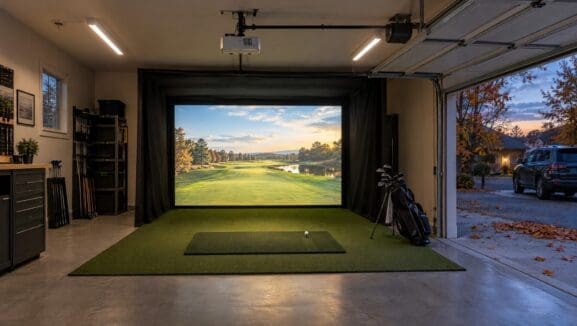
Not every golfer wants the “venue” experience. A huge portion of indoor golf growth is tied to home and private installations—garages, basements, barns, spare rooms. Axios profiled a company selling at-home simulators around $10,000 and emphasized how bundling turf, net, screen, projector, and software simplifies the installation journey for consumers (Axios Charlotte). In other words: demand created a market for “one call” solutions.
And in UGC spaces, the DIY side of this sub-industry is thriving. A Reddit post in r/golf describes building a garage simulator/practice setup and calls it a “full-blown family hangout spot,” complete with a walkthrough of what worked and what didn’t (r/golf post). That’s a consumer behavior signal: the simulator becomes more than practice—it becomes a household activity.
Meanwhile, in a highly upvoted r/golf thread about opening an indoor facility, the author shares cost figures and buildout details in the comments—including a mention that each simulator was “about $40k” turnkey and the “total buildout” was “about $800k” (r/golf thread). Even if those numbers reflect one specific project, they illustrate why installation, buildout, and vendor coordination have become real businesses: the capital stack and complexity are big enough to justify specialists.
“What started as a way to practice during the winter turned into a full-blown family hangout spot.”
— Reddit user, sharing a DIY home simulator/practice setup (Source)
Sub-Industry #5: Indoor Leagues, Tournaments, and New Competitive Formats
When indoor golf becomes “always available,” competition can become “always on.” The clearest example at the professional spectacle level is TGL, which Reuters described as blending virtual and real-life elements inside a dedicated arena and packaging it for broadcast entertainment (Reuters). But the more important growth story for everyday golfers is the expansion of amateur and local competitive ecosystems.
On the commercial simulator side, the GOLFZON Tour announcement describes a tournament format where players at indoor simulator facilities across regions compete for a prize purse (GOLFZON Tour announcement). Business Wire later reported that Season 2 expanded qualifying access to facilities worldwide that have eligible simulator hardware, with a stated prize purse for the championship match (Business Wire). Whether you love or hate brand-run tours, the underlying point is undeniable: indoor golf is creating its own competition lanes.
At the local operator level, UGC advice repeatedly centers leagues as the retention engine. In a smallbusiness subreddit thread about opening an indoor golf simulator business, one commenter pushes “league leagues leagues” as “an absolute must,” describing multiple league types (members-only, public, kids, seniors, etc.) (r/smallbusiness thread). That’s how a venue turns “try it once” into “I’m there every Wednesday.”
Sub-Industry #6: Year-Round Practice, Data-Driven Coaching, and Skill Development
Indoor golf growth isn’t only “more places to play.” It’s also “more structured ways to improve.” The USGA’s 2025 Golf Scorecard highlights continued growth in recorded play patterns, including a record number of 9-hole rounds and growth in Handicap Index holders (USGA). While that USGA reporting is about score posting (not simulators), it underscores how golfers are increasingly blending formats and time commitments—an environment where indoor practice and compact sessions fit naturally.
In UGC threads about running or teaching at simulator facilities, seasonality and “practice-first” usage comes up repeatedly. In a r/Golfsimulator thread about summer slowdown, a commenter who teaches lessons at a simulator facility describes a “huge drop off” in summer compared to winter, noting that some customers still come for the data and practice (r/Golfsimulator thread). That’s not a marketing line—it’s the lived rhythm of how golfers use indoor golf when outdoor is available.
The result is a sub-industry that looks a lot like “year-round training infrastructure”: coaching offerings inside sim venues, dedicated practice memberships, off-season skill development, and lessons that don’t depend on daylight. In one r/Golfsimulator thread about starting a simulator business, the commenter recommends dedicating a bay to lessons and targeting serious golfers and teams, describing lessons as a key revenue stream alongside memberships and events (r/Golfsimulator thread). That’s indoor golf turning into a training business, not just a novelty.
What Golfers Get: More Golf, Different Golf, and “Golf When You Can”
If you’re a golfer, the real “indoor vs outdoor” conversation is less about picking sides and more about removing friction. Indoor golf offers a predictable environment when outdoor golf is constrained by weather, limited daylight, or time. Reporting on simulator bars frames the appeal as year-round play in a social environment that can include non-golfers, which changes who gets invited—and how often the group says yes (Axios Denver).
It also changes the “unit” of golf. Instead of planning a half-day around 18 holes, a golfer can book one hour and still feel like they played. That shift matches broader industry signals that golf participation includes more off-course formats and that total participation has grown significantly over the past decade (NGCOA / American Golf Industry Coalition talking points citing NGF). In practical terms, indoor golf is a gateway for consistency: more swings per week, more reps, more touch with the game.
And it’s not just “serious” golfers. The tone of UGC posts—especially home-build and venue threads—often frames indoor golf as family time, a hangout spot, or a social outlet. A DIY simulator post describes the setup becoming a “family hangout spot,” not just a winter grind station (r/golf post). That matters because habits compound: when golf becomes easier to say yes to, it grows.
What Business Owners Get: New Models, New Risks, New Moats
For business owners, the indoor golf boom created opportunity—but also a new competitive landscape. In UGC discussions, you’ll see both excitement and caution: one thread claims many bays opened near the commenter and worries about saturation, while replies debate barriers to entry and emphasize differentiation (r/Golfsimulator thread). This is the “gold rush” phase: growth attracts operators, and operators quickly learn that “having sims” is not the same as “having a business.”
The strongest operators seem to build moats around experience and retention. Multiple UGC advice threads converge on the same levers: memberships, leagues, events, and a compelling vibe. A r/Golfsimulator commenter recommends hosting weekly tournaments, kids’ nights, and happy hours, and explicitly points to recurring monthly revenue through memberships (r/Golfsimulator thread). Another r/golfsimulatorbusiness thread highlights cleanliness, hidden costs, and operational discipline as the difference between “cool idea” and “sustainable operation” (r/golfsimulatorbusiness thread).
There’s also the “seasonality reality,” especially in climates with real summers. In a thread about summer slowdown, a commenter who teaches at a simulator facility describes the summer being “almost completely dead,” even while acknowledging a smaller cohort that still shows up for practice data (r/Golfsimulator thread). That doesn’t mean indoor golf fails—it means owners have to design offers that smooth the curve (leagues, memberships, corporate events, AC-escape days, and community programming).
How GolfSimSpot Helps You Navigate the Indoor Golf Boom
Whether you’re a golfer or an operator, indoor golf is now a real lane alongside traditional golf—not a novelty. Industry talking points continue to frame off-course participation as the major growth engine within golf engagement (NGCOA / American Golf Industry Coalition talking points citing NGF), while mainstream reporting documents the on-the-ground expansion of simulator venues and concepts in local markets (Axios Denver) (CT Insider). That combination—macro growth and micro expansion—is exactly the environment where discovery becomes valuable.
GolfSimSpot exists to make that discovery easier. If you’re a golfer, you can use it as a starting point to find indoor golf options, compare offerings, and explore what’s available in your area (GolfSimSpot.com). If you’re a business owner, the same ecosystem helps you understand what’s out there—and how customers search for these experiences.
And if you operate in any of the “new sub-industries” this article covered—venues, memberships, leagues, 24/7 concepts, coaching, or even installation and services—being discoverable matters. Indoor golf is growing because it fits modern life. Visibility is how you catch that demand when golfers are searching for a place to play tonight, not next Saturday. (Explore the directory at GolfSimSpot.com.)
Sources
- NGCOA / American Golf Industry Coalition — “National Golf Day 2024: Golf Industry Talking Points” (link)
- USGA — “Golf Participation Boomed in 2025; More Than 82 Million Rounds Posted Domestically” (link)
- Reuters — “From dream to virtual reality, Woods and McIlroy’s indoor league has debut match” (link)
- Axios Denver — “The indoor golf bar bonanza swings into action in Denver” (link)
- CT Insider — “Five Iron Golf picks Norwalk for first Connecticut location…” (link)
- Axios Charlotte — “Play Quail Hollow with $10,000 golf simulator from Charlotte company” (link)
- Reddit (r/golf) — DIY home simulator/practice setup post (link)
- Reddit (r/golf) — “Chasing my dream of opening an indoor golf facility” thread (includes cost figures in comments) (link)
- Reddit (r/Golfsimulator) — “Starting my own Golf simulator business” thread (link)
- Reddit (r/golfsimulatorbusiness) — “Opening a golf simulator. Advice appreciated” thread (24/7 automated concept) (link)
- Reddit (r/Golfsimulator) — “Does anyone actually think starting a Golf Sim Lounge business is a good idea?” thread (link)
- Reddit (r/Golfsimulator) — “Summer Slowdown” thread (link)
- Reddit (r/smallbusiness) — “Indoor Golf Simulator Business” thread (leagues emphasis) (link)
- GOLFZON Tour — “Introducing the GOLFZON Tour” (link)
- Business Wire — “GOLFZON America Launches GOLFZON Tour Season 2” (link)
- GolfSimCloud — Indoor golf booking & management platform (link)
- Golf O’Clock — Indoor golf booking & management platform (link)
- Birrdi — Indoor golf booking & management software (link)
- GolfSimSpot — GolfSimSpot.com (link)