
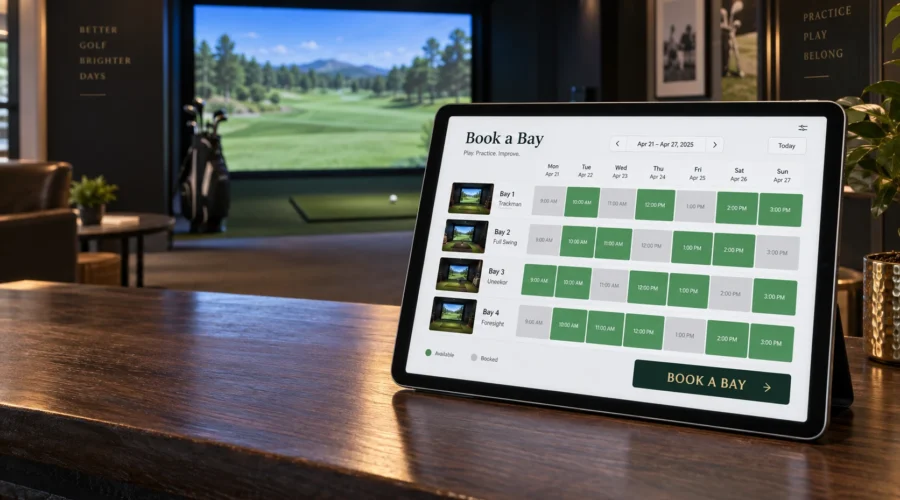
Golf Simulator Booking Software: 9 Platforms Compared, With Real Prices
Quick answer: Nine platforms compete to run the front desk of a golf simulator venue. Published prices run from $50 per bay per month at GolfBooking up to $347 a month for the unstaffed tier at Butter. Golf O’Clock sits in the middle at $150 a month for four bays, while Birrdi skips monthly fees and charges $1.00 to $0.25 per reservation instead.
If you run unstaffed hours the door lock matters more than the calendar, and only some of these platforms control bay power and door entry. We read every price on the vendor’s own pricing page in September 2026, and we earn no commission from any company named here.
First, the disclosure that belongs at the top of a post like this: we are not paid a commission on any of these platforms. Nobody bought a place in the comparison, and Golf Sim Spot has no affiliate or referral deal with any company named below. That is worth saying plainly, because most of the other “best booking software” articles you will find were written by the software companies themselves.
Seven of the nine publish a price you can read without talking to a salesperson. The other two make you book a demo first. That difference tells you a lot about the buyer each company is built around. It is also the fastest way to narrow a shortlist when you have a room to open.
Everything here came from each vendor’s own pricing and feature pages, read on 18 September 2026. Where a company keeps its rates private, we say so rather than guessing. Where a feature is not stated publicly, we left the cell blank instead of assuming.
Booking software and simulator software are two different purchases
Google mixes these up constantly, and the confusion costs operators real time. Separate them before you compare anything.
Simulator software is the game running on the screen, which means GSPro, E6 Connect, TGC 2019 and Awesome Golf. It is the product your customers see and talk about. We cover how it pairs with launch monitors in the guide to how golf simulators work.
Booking software is what runs the business behind the bay, taking the reservation, charging the card and tracking memberships. On several of these platforms it also unlocks your front door and powers the bay on when the hour starts. Customers rarely learn its name, but you will be inside it every day you operate.
This comparison covers the second one, because picking a game engine for the screen is a genuinely different decision with different winners.
Golf simulator booking software compared
| Platform | Published price | Pricing model | Door & bay control | Good to know |
|---|---|---|---|---|
| Golf O’Clock | $150/mo, 4 bays | Per bay, +$25 each | Yes | No contract, billed monthly |
| Birdie | From $197/mo | Flat rate | Yes | No per-booking fee or revenue share |
| Butter | $247 or $347/mo | Tiered, 4 bays | Yes, on Pro | Built by a former facility owner |
| GolfBooking | $50/bay/mo | Per bay | Yes | Volume discounts for bigger venues |
| Birrdi | $1.00 to $0.25 | Per reservation | Yes | Turns launch monitors on and off |
| VTee Golf | Under $1/booking | Per booking | Yes | Leagues and website builder included |
| Active Booker | $79/mo, 2 bays | Per bay, +$10 each | Not stated | Same platform also sells to axe bars |
| Playbypoint | Not published | Demo required | Not stated | Also runs tennis and pickleball clubs |
| Whoosh | Not published | Demo required | Not stated | Square and Lightspeed integrations |
Prices read from each vendor’s own pricing page on 18 September 2026. A blank cell means the company does not state it publicly, not that the feature is missing. Confirm current rates before you sign anything.
What indoor golf booking software actually costs
There are three pricing models on this list. The right one depends on how many bays you run and how busy they are.
Flat monthly pricing is the easiest to budget around. Birdie charges from $197 a month and states there are no per-booking fees, no percentage of revenue and no long-term contract. Butter runs $247 a month on its Standard plan when billed annually, covering up to four bays.
Per-bay pricing scales with the size of your room rather than your traffic. GolfBooking charges $50 per bay per month, with volume discounts for larger venues. Golf O’Clock asks $150 a month for four bays, then $25 for each bay after that. Active Booker starts lower at $79 a month including two bays, adding $10 per extra bay.
Running those numbers against a real room makes the gaps obvious. A six-bay facility pays $300 a month on GolfBooking and $200 on Golf O’Clock. At two bays the comparison flips, to $100 against $79 on Active Booker.
Per-reservation pricing charges for bookings instead of bays. Birrdi starts at $1.00 per reservation under 100 bookings a month, falling to $0.60 up to 500 bookings, $0.40 up to 1,000, and $0.25 above that. VTee Golf uses a similar structure and advertises a rate under a dollar.
That model rewards a quiet winter and charges more in your best months, so model it honestly before committing. A room selling 900 bookings a month pays Birrdi roughly $360, while the same room on GolfBooking pays $50 per bay however many rounds it sells.
Why 24/7 venues need access control and not just a calendar
This is the requirement generic scheduling tools miss completely. It should shape your shortlist before anything else does.
An unstaffed simulator room has to do two things a hair salon never does. It has to let a paying customer through a locked door at eleven at night. It also has to power the bay on when their hour starts and shut it down at the end.
Several platforms handle that directly rather than leaving you to bolt something on. Golf O’Clock integrates with Kisi, Avigilon, RemoteLock and Rhombus smart locks, and says it recommends the right setup during onboarding. Birdie lists Kisi, PDK, UniFi Access, Avigilon Alta and RemoteLock, and sends customers a time-gated SMS unlock link rather than a keypad code.
Birrdi runs RemoteLock integration for the door. It also connects to Uneekor, ProTee VX, Golf VX, IDRA and E6 Connect, switching launch monitors on and off around a booking. Butter puts bay access control on its $347 Pro plan, which the company describes as the tier for running unmanned.
If overnight hours are part of your model, make this the first question you ask a salesperson. A booking calendar alone will not let anybody into the building.
The platforms that publish their prices
Golf O’Clock
This is the clearest pricing page of the nine. Standard Setup runs $150 a month for your first four bays, plus $25 a month for each additional bay. A Custom Automation tier starts at $300 a month for the first ten bays, aimed at venues needing custom scripting or deeper automation.
The company states plainly that there is no contract and that billing is monthly. Its site is organised around unstaffed operations, with dedicated sections for unmanned venues, hybrid facilities and multi-location operators.
Butter
Butter publishes two tiers and quotes the third. Standard is $247 a month billed annually and covers up to four simulator bays. Pro at $347 a month adds bay access control and the pieces needed to run unstaffed. Enterprise pricing is quoted individually for franchises and multi-location operators.
The company says the product grew out of years spent owning and operating an indoor golf facility, and the tier structure reflects that. The jump from Standard to Pro is the jump from staffed to unmanned, which is the decision most operators are actually making.
GolfBooking
One rate, $50 per bay per month, with volume discounts for larger venues. Payments run through Stripe, Square or Paystack. The published feature list covers digital waivers, gift cards, a waiting list, dynamic rates and a drag-and-drop tee sheet.
That flat per-bay number makes this the simplest platform to weigh against your revenue per bay, which is the calculation that should drive the decision anyway.
Birrdi
Birrdi prices per reservation rather than per bay or per month. The rate falls in four steps as monthly volume grows past 100, 500 and 1,000 bookings.
Its hardware integration is the detail worth knowing. Birrdi connects to Uneekor, ProTee VX, Golf VX, IDRA and E6 Connect, and can turn those systems on and off around a booking. Memberships, recurring billing and Square POS sit alongside the booking engine itself.
Birdie
Flat rate from $197 a month, and the company is unusually direct about what that excludes. There are no per-booking fees, no percentage of revenue and no long-term contract. Higher tiers bundle a website and managed marketing at prices quoted on request.
Payments run through Square, Stripe or Clover, and the company says onboarding is done for you with most venues live inside about 24 hours.
VTee Golf
VTee charges per booking and advertises a rate under a dollar. The company publishes a lot about leagues, smart lock integration and its website builder, and its blog is written for operators rather than golfers.
Active Booker
Pricing starts at $79 a month including two bays. Each additional bay adds $10 a month, across a published table running to twelve bays. One thing is worth knowing before you shortlist it. The same platform is sold as Axe Booker to axe-throwing venues, so this is a general activity booker rather than a golf-first product.
The platforms that make you ask for a price
Playbypoint and Whoosh both build for simulator venues, and neither publishes a rate anywhere we could find. We checked both in September 2026, and Playbypoint’s pricing URL returned a page-not-found error while Whoosh has no pricing page listed in its sitemap.
That is not a mark against either product, because larger platforms often price by facility size and cannot publish one number. It does mean you cannot compare them on cost without booking a call, so build that time into your search.
Playbypoint also runs tennis, pickleball and swim clubs from the same platform, and says it offers 24/7 live support from operational specialists. Whoosh works across public and private golf operations, and lists Square and Lightspeed integrations on its site.
What simulator owners say in the operator forums
We read 220 posts and comments across r/golfsimulatorbusiness and r/Golfsimulator. The point was to see which names actually come up when owners talk to each other.
Butter was mentioned far more than any other platform. Several of those mentions came from people describing their own facility rather than selling anything. Birdie, VTee and GolfBooking each appeared a handful of times, and Birrdi came up once despite ranking first in Google for most of these searches.
Read those threads with your eyes open, though. A noticeable share of the recommendations come from founders and staff at the platforms being recommended. To their credit, several of them say so in the post itself. Absence from the forums is not a quality signal either. The platforms selling to larger multi-bay operations tend to do it by sales call rather than in public.
One question raised in those threads deserves to be on every operator’s list, and no vendor volunteers it. Ask whether the software takes a percentage of your transactions on top of the monthly fee. A revenue share can quietly cost more than the subscription ever does.
Course systems that also handle simulator bays
Clubspeed, Club Caddie, foreUP, Golfmanager and Lightspeed Golf all serve golf courses and entertainment venues. Some of them run simulator bays as one attraction among several.
Clubspeed publishes a Core tier at $399 a month and a Premium tier at $699. Annual billing drops those to $319 and $559, with Enterprise quoted on request. The platform is built for family entertainment centres, so karting and bowling sit alongside golf in the same product.
Systems like these make sense when simulators are one part of a larger operation with a restaurant or pro shop attached. For a room that mainly sells bay time, the simulator-first platforms above fit closer and usually cost less.
About these recommendations
Nobody paid to be included here and nobody paid for position. Golf Sim Spot has no sponsorship, affiliate or referral relationship with any company named in this post. We earn nothing if you sign up with any of them. Every price came from the vendor’s own published pricing page on 18 September 2026, and software pricing changes often. Do your own due diligence, ask for a trial, and get the terms in writing. This article is information rather than business or financial advice.
How to choose without losing a month to sales demos
Start with your bay count and your opening hours. Those two numbers eliminate most of this list before you speak to anybody.
A two-bay room keeping standard hours should look hardest at flat and per-bay pricing. The monthly cost stays small and predictable. A six-bay room running overnight needs real access control, which narrows the field to platforms that name their smart lock partners. A high-volume venue should model per-reservation pricing carefully, because that bill grows fastest in the months you are celebrating.
Then ask every vendor the same five questions, and write the answers down. Does the platform unlock my door and power my bays, and with which hardware? Does it take any percentage of my transactions on top of the monthly fee? Which payment processor am I tied to? What happens to my customer list and booking history if I leave? Is there a contract, or can I cancel month to month?
If the room itself is still being built, this decision can wait a few weeks. Get the room dimensions right first, then price the full build before you go shopping for software. Anyone building the bays themselves should start with the DIY build guide. Anyone weighing a brand against going independent should read the franchise guide, because several franchises pick the booking platform for you.
Frequently asked questions
What is the best software for booking indoor golf simulators?
There is no single winner, because the answer changes with your bay count and your hours. A small staffed room usually does best on flat or per-bay pricing, while an unstaffed room needs a platform that names its smart lock partners.
How much does golf simulator booking software cost?
Published rates run from $50 per bay per month up to $347 a month for a fully unstaffed setup. Per-reservation platforms charge between $0.25 and $1.00 per booking depending on volume, and several vendors quote privately rather than publishing at all.
How much does Birrdi cost?
Birrdi publishes per-reservation pricing rather than a monthly fee. It is $1.00 per reservation under 100 bookings a month, $0.60 up to 500, $0.40 up to 1,000, and $0.25 once you pass a thousand.
Is there free golf simulator booking software?
None of the nine simulator-first platforms we checked publishes a free plan. Some general scheduling tools are free at low volume. None of those will unlock a door or power down a bay, which is usually the whole reason an operator goes looking.
What is the best software for golf simulators on the screen?
That is simulator software rather than booking software, and the usual shortlist is GSPro, E6 Connect and TGC 2019. Your launch monitor decides which of those you can actually run. Our launch monitor guide covers which pairings work.
What is the best software for booking golf tee times?
Tee sheet software for outdoor courses is a separate category with different leaders. The names that come up most are foreUP, Lightspeed Golf, Club Caddie and Golfmanager, and several of them also handle simulator bays for clubs running both.
Do I need separate access control software?
Only if customers need to get in when nobody is on site. Kisi, RemoteLock, PDK, Avigilon and Rhombus are the systems these booking platforms name most often, and most integrate with them rather than replacing them outright.
Can booking software turn my simulators on and off?
Some can, though you should never assume it. Birrdi states it integrates with Uneekor, ProTee VX, Golf VX, IDRA and E6 Connect for exactly that. Any vendor should confirm compatibility with your launch monitor before you sign.
Are golf simulator businesses profitable?
Margins depend on utilisation far more than on software, and an idle bay costs the same whichever platform you run. We break down the real numbers in the guide to starting a golf simulator business, and compare brand economics in the franchise guide.
See how working rooms package their hours
A pricing page tells you what software costs, not how a profitable room actually sells its time. Looking at how venues in your market structure hourly rates, memberships and league nights is often a faster education than another demo call.
We track every simulator venue in the country, and the current count sits in our breakdown of how many golf simulator venues are in the US. City guides like Chicago and Nashville show the hourly rates and membership tiers real rooms charge.
Browse golf simulator venues by city to see how rooms near you price bay time and build membership tiers.
Prices and features change regularly. Every figure here was read from the vendor’s own website on 18 September 2026, so confirm current terms with the company before buying.